
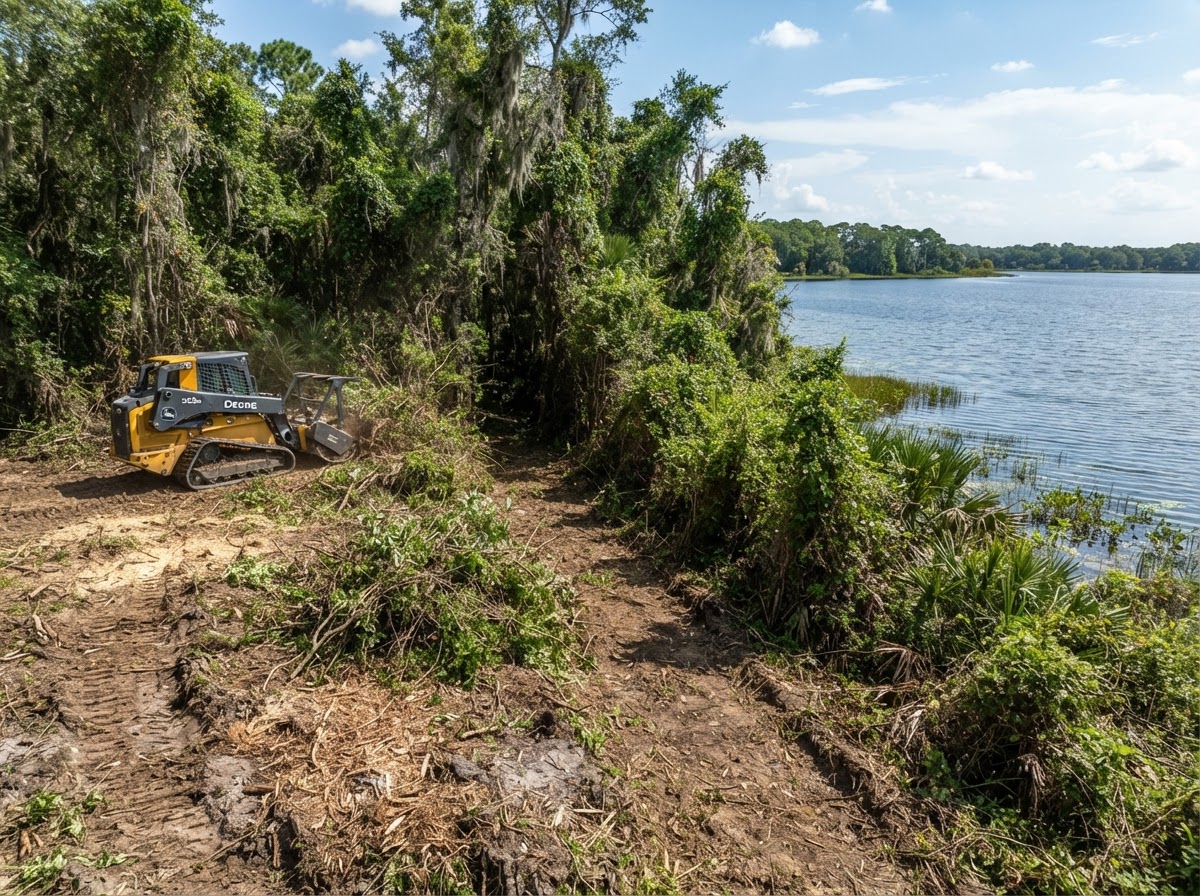
Land clearing, in Project 7's scope, is the clearing of overgrown waterfront-adjacent land — dense underbrush, vines, invasive Brazilian pepper trees, and fallen logs — to prepare a lot for landscaping, dock access, a beach, or outdoor living, while protecting the shoreline from erosion. We perform this work across Orlando and Central Florida without chemical sprays. Request a free estimate and we will review the lot's overgrowth, access, and shoreline context before confirming scope.
What Land Clearing Includes
- Waterfront lot brush clearing
- Underbrush and invasive species removal
- Downed tree and log removal
- Access path and easement clearing
- Site preparation for landscaping
- Debris haul-away and cleanup
- Shoreline-aware clearing that protects the bank
- Selective preservation of stabilizing vegetation
The Problem Land Clearing Addresses
An overgrown waterfront lot is unusable and, left alone, gets worse. Invasive Brazilian pepper, vines, and thick underbrush crowd out everything else, hide the shoreline, and make the path to the water impassable. Fallen logs and downed limbs accumulate after storms. For a lot you want to landscape, build a dock approach on, or turn into a beach or outdoor living area, that overgrowth has to come out first — carefully, because the shoreline is right there.
The challenge is doing it without causing erosion. Heavy-handed clearing on a waterfront bank can destabilize the edge and send sediment into the water, so the work has to respect the contour and the stabilizing roots that matter. It is clearing for use, not site-development construction. The difference matters: a cleared lot is ready for the next stage; a graded or excavated lot is a different service and a different contractor.
Brazilian pepper is one of the most common and aggressive invaders on Central Florida waterfront lots. It forms dense thickets that crowd out native plants, provides poor habitat, and grows back quickly if cut without follow-up. Removing it opens the lot up dramatically, but because it is invasive and persistent, clearing is usually the first step in a longer plan to keep the lot from being recolonized.
Vines and undergrowth are the other half of the problem. Vines smother trees and shrubs, and thick underbrush hides the actual terrain — slopes, soft spots, debris — that you need to see before you can landscape or build a path. Clearing it reveals the real lot underneath and makes the next stage of work possible.
Because waterfront-adjacent lots regrow aggressively, clearing is often the first step in a larger lakefront or landscaping project rather than a standalone permanent fix. A lot that is cleared and then left will regrow, so clearing is best paired with a plan for what comes next — landscaping, a beach, a dock approach, or a maintenance routine that keeps the lot open.
Who This Service Is For
Waterfront lot owners
Owners preparing an overgrown lakefront lot for landscaping, a beach, or outdoor living.
Lakefront homeowners
Owners clearing the upland approach to a dock or water edge.
HOAs & community properties
Neighborhoods reclaiming overgrown common waterfront areas.
Property managers & developers
Teams preparing waterfront-adjacent lots for landscaping or access.
Buyers of overgrown waterfront property
New owners who need to see and access the lot they just purchased.
Our Approach & Methods
Brush & invasive clearing
We clear underbrush, vines, and invasive Brazilian pepper from the upland lot while preserving stabilizing bank vegetation where it protects the shoreline.
Downed tree & log removal
Fallen limbs and logs are cut and hauled away so the lot is safe and ready for the next stage of work. Storm debris is a common reason owners call.
Access path & easement clearing
We open access paths and easements so the waterfront and the lot are usable and connected. A clear path to the water is often the first thing owners want.
Shoreline-aware site prep
Clearing is done with the shoreline in mind to avoid erosion, preparing the lot for landscaping or beach work without destabilizing the bank. We preserve the roots that hold the edge.
Selective preservation
We do not clear everything wholesale. Native vegetation with stabilizing roots is preserved where it protects the bank, so clearing opens the lot without creating an erosion problem.
Benefits, Limitations & Environmental Considerations
Land clearing turns an overgrown, unusable lot into a clean, accessible site ready for landscaping, a dock approach, or a beach — increasing usable footprint and value. The limitation is scope: this is clearing of overgrowth and debris, not demolition, excavation, grading, forestry mulching as a separate service, or construction-site development. We do not perform grading, excavation, or structural construction. Where the lot meets the water, clearing is shoreline-aware to avoid erosion, but we are not erosion-engineering or stormwater-certification services. For a bank with active erosion, clearing is one step; a structural solution would need a separate engineer. We will flag that rather than attempt it.
Our Project Process
From project review to a completed waterfront — clear steps, no instant-price promises, scope confirmed before any work begins.
Lot review
We assess overgrowth type and density, the shoreline context, access, and what the lot is being prepared for.
Clearing plan
We recommend brush, invasive, and debris clearing that protects the shoreline, and confirm scope before starting.
Non-toxic clearing
We clear underbrush, vines, and downed material, open access, and haul debris away without chemical sprays.
Ready site & next steps
You get a clean, accessible lot and guidance on landscaping, beach, or LakeMat next steps where useful.
Preparation, Access & What to Expect
Tell us what the lot is being prepared for — landscaping, a dock approach, a beach, outdoor living — so clearing is shaped to that goal. Identify property lines, easements, and anything to preserve. Flag the shoreline edge so clearing is done without destabilizing the bank. No chemical treatment is needed; clearing is physical.
For gated or HOA lots, share access details and any community rules. If downed logs or storm debris are involved, let us know the volume so we bring the right hauling. Storm debris can be surprisingly heavy and voluminous.
If the lot has Brazilian pepper or other invasives, mention it. Invasive clearing is a core part of the service, but because invasives regrow, we will set realistic expectations about follow-up to keep the lot from being recolonized.
What to Expect
- Expect a lot review covering overgrowth type and density, the shoreline context, access, and what the lot is being prepared for before scope is confirmed.
- On the visit, expect underbrush, vine, and invasive clearing, downed-log removal, and access-path opening — physical work with no chemical sprays on the lot or shoreline.
- Expect the actual terrain — slopes, soft spots, and buried debris — to become visible once the growth is cleared, which is often the first real look at the lot.
- Expect the lot to be ready for the next stage, whether that is landscaping, a dock approach, or a beach, with the shoreline protected from erosion during the process.
- Expect regrowth, especially with invasives like Brazilian pepper present, so clearing is best paired with a plan for what comes next rather than treated as a permanent fix.
- Expect us to preserve stabilizing bank vegetation rather than clearing wholesale, to avoid destabilizing the water edge and sending sediment into the lake.
- Expect honest scope: clearing of overgrowth and debris only — not demolition, excavation, grading, forestry, or construction-site development.
Maintenance & Regrowth Considerations
Cleared waterfront-adjacent lots regrow, so follow-up clearing keeps the lot usable and the access open, especially after storm seasons. Because we remove material rather than spray it, less accumulates between visits. A lot that is cleared and then left will regrow, so clearing is best paired with a plan for what comes next.
If the cleared lot is headed toward a beach or high-traffic water edge, a LakeMat or SandMat can hold the result — suppressing bottom weeds or keeping sand above muck. We will tell you whether that fits your lot rather than defaulting to it. Most cleared lots do well with a maintenance routine once the initial clearing is done and the next stage is underway.
Cost Factors
Land clearing estimates depend on lot size, overgrowth density and type, downed-debris volume, shoreline context, access, and disposal. A small lot with light brush is a very different scope from a large overgrown waterfront lot with dense Brazilian pepper, vines, and storm debris. We give a free, transparent estimate after reviewing the lot — never a guessed price. Contact us to request one, and we will walk through what is driving the scope.
Confirmed Coverage
We clear waterfront-adjacent land across Orange, Seminole, and Osceola counties and nearby Central Florida communities. Send the property address and we will confirm coverage and access.
Why Choose Project 7 Services
- Clearing scoped to waterfront-adjacent overgrowth, not construction
- Shoreline-aware work that avoids erosion
- Non-toxic removal of invasives and downed debris
- Prepares the lot cleanly for landscaping or a beach
- Selective preservation of stabilizing bank roots
- Honest about scope — no grading, excavation, or construction
Signs You May Need Land Clearing
- Your waterfront-adjacent lot is overgrown with brush, vines, and underbrush
- Invasive Brazilian pepper has formed dense thickets that crowd out everything else
- Fallen logs and downed limbs have accumulated after storms and make the lot unusable
- The path to the water is impassable and overgrown
- You cannot see the actual terrain — slopes, soft spots, debris — through the growth
- You want to landscape, build a dock approach, or create a beach but the lot is not ready
- The lot is shoreline-adjacent and heavy clearing risks erosion if done carelessly
- You just bought an overgrown waterfront property and need to see and access it
- An HOA common waterfront area is overgrown and residents want it reclaimed
- The lot has been left for a season or more and the regrowth is overwhelming
Understanding the Differences
Land clearing vs. lakeshore clearing
Land clearing addresses the broader waterfront-adjacent lot — underbrush, invasives, and downed logs across the upland. Lakeshore clearing focuses on the narrow bank at the water's edge. If the whole lot is overgrown, it is land clearing; if the immediate shoreline is the issue, it is lakeshore clearing.
Land clearing vs. excavation or grading
Project 7's land clearing removes overgrowth and debris to prepare a lot for the next stage. We do not perform demolition, excavation, grading, forestry mulching as a separate service, or construction-site development. A cleared lot is ready for landscaping; a graded or excavated lot is a different service and a different contractor.
Clearing vs. wholesale clearing
We clear selectively, preserving native vegetation with stabilizing roots where it protects the shoreline, rather than stripping the lot bare. Wholesale clearing can destabilize the bank and cause erosion. Selective clearing opens the lot while keeping the water edge structurally sound.
One-time clearing vs. maintenance
A one-time clearing opens an overgrown lot and prepares it for the next stage. Because waterfront-adjacent lots regrow aggressively, especially with invasives present, clearing is best paired with a plan for what comes next — landscaping, a beach, or a maintenance routine that keeps the lot open.
Ask About LakeMat®
After cleaning, LakeMat weed-control mats can help keep targeted shoreline, dock, and swimming areas clearer without chemicals.
Land Clearing FAQs
Request a Free Estimate
Get a transparent quote for land clearing at your property.
Call (407) 865-1219Get a Free Estimate